Chunlei's Blog

刹那是永恒

中国人过春节才算是真正意义上的过年,因为有一个仪式,一家团圆,包饺子,看春晚。一年的劳累,一年的委屈,一年的收获,都在这一天得到释放和松弛。

想想自己一年所做的事情,还是觉得很多事都没有做完,或者可以做的更好。但是人只能努力的走好脚下的路,劳累的,困顿了,迷茫了,休息一下,然后重新开始新的冲刺。

在前行的路上,任何组织或个人都会犯两种错误,一是该做的没做,二是不该做的做了。前者是失职,后者是妄为。避免第一类错误的方法是让该做的变成自己喜爱做的,这样就不容易失职,选择自己喜欢的职业就是这个道理。对于第二类错误,则需要把监督的权利交给超出自己控制范围的独立第三方甚至对手,这样就会只有小错而无大过,因为异己的监督会让你时刻警惕自己铸下大错。

中国面临的环境污染问题,空气污染,水污染,既有相关部门的失察失职,也有个别企业和个人的无德妄为。我们需要更好的配置机制,让喜欢做并且能做好相关工作的人得到这个工作的职位,同时也需要建立起真正的监督机制,防止任何组织或个人铸下大错。环境问题可以说已经触及到了民众生存的底线,它直接关系到一个一个个体的生命和健康,也关系到子孙后代的健康幸福,没有一个中国能置身事外。

正像 @刘咚咚 的那首雾霾版《卷珠帘》唱的一样, 让蓝天早日重现!

最后真情的嘱咐大家,春节快乐!
今年春节不放炮,平安环保健康好!

Today is an amazing day. I volunteered to be a score keeper in the Science Bowl in UGA. It is a competition of science questions for high school students like the game of Jeopardy. There are two types of question: buzz-in question and bonus question. Every player in both team can buzz-in and give the answer, if the answer is correct then they got 4 points and got a bonus question for their team, they can discuss the question together and answer it, if correct they got another 10 points, if wrong no points. I attended a training session for volunteers to be a score keeper. I am kind of exited because I don’t know what would it be going like.

But in the Morning when I got up at 7:00, I began to worried about the bus. Today is Saturday and the UGA bus would not run so early. I promised to be there before 8 am. So I went to the city bus stop to check if the city bus can take me there on time. Unfortunately the first No 5 bus will be at 8:20. What should I do? I realize the incontinence of not having a car. I ran to the next stop where both the UGA bus and the city bus stop, hoping the UGA bus can come. But when it is 7:20, no bus come. I became helpless. A crazy idea came to my mind. Why not run there. So I began to ran with my laptop in my backpack. Usually it will took me 30 minutes to Aderhold by bus. But I just had 40 minutes. I did not think I could make it. But I really don’t want to be late because the score form is still in my driver, to make sure everything goes well with the competition I have to make it. It was also my first time to run alone by myself to Aderhold. At first, I felt cold because of the wind, later my back got so warm that I began to sweat. The road is hilly. When I was climbing uphill, I was nearly out of breadth. The police car passed me several times, very few people on the road this early morning. They might thought this guy was kind of strange, he ran on the road but with a heavy backpack. I did not quiet understand myself either, why I brought my computer with me. It is just a habit. A brave idea hit me several times: Can I ask the police for a ride. It would be wise and abrupt. At about 7:50, I saw Georgia center, I could not believe myself. It just took 30 minutes to get there. I regained my confidence to get there on time. I start ran more quickly. Finally I arrived at Aderhold at 7:58. It is amazing, isn’t it?

I am kind of curious what drive me forward and finally make it at several times that I nearly gave up? No matter what it is, it is powerful. And if you have this power, nothing is impossible.

统计学中有很多概念很抽象不容易理解,但是如果有恰当的例子作桥梁,就可以深入浅出,容易让人领悟了。

最近尝试学习一些关于项目反映理论(IRT)的东西,觉得很多学习资料都使用公式吓唬人,并没有把这个概念浅显化和生活化。总之,这些资料不够友好,让初学者望而生畏。

那么什么是项目反映理论呢?我试着解释解释。这样从测量开始说起。举个例子,推铅球比赛。每个运动员都会按照规定选择一定大小的铅球站在指定的地点,用尽全力把球向着一个方向推出去。然后裁判会用尺子测量落地点与原点的距离,读出读数作为成绩。实际上测量的是选手的推力和推送技巧,它有一个理论的真值。而裁判的读数则是观测值。但是理论值并不等于观测值。理论值=观测值+误差。这就是经典的测量理论。但是铅球有不同重量和大小,假如在比赛记录中,有两个不同时期的运动员,一个用的是15斤,一个是10斤,前者推了15米,后者推出了20米,那么那个选手的成绩更好呢。这个时候经典测验理论就无能为力了,要解决这个问题必须要再把两个运动员找来,用同一个铅球重新比过。但是项目反映理论则可以解决这个问题。

实际上,教育测量往往比这个情境还要复杂。推铅球我们还能直接测量然后读数,即使有误差,多测几次就能减少误差。当是教育测量则通常是纸笔测验,这个题答对那个题每答对,最后有个总分。那么这个总分就是我们学生的学业能力吗?当然不是,比如这张试卷一共十个题目。有些简单题目很多人答对,有些难题则很少人答对。假如有两个学生都得了8分。一个学生把难题都做对了,但是简单题却错了两个。另外一个则是两个最难的题目都做错了。那么他们的学业能力真的一样吗?你觉得谁的学业能力应该更强一些?(想一想)

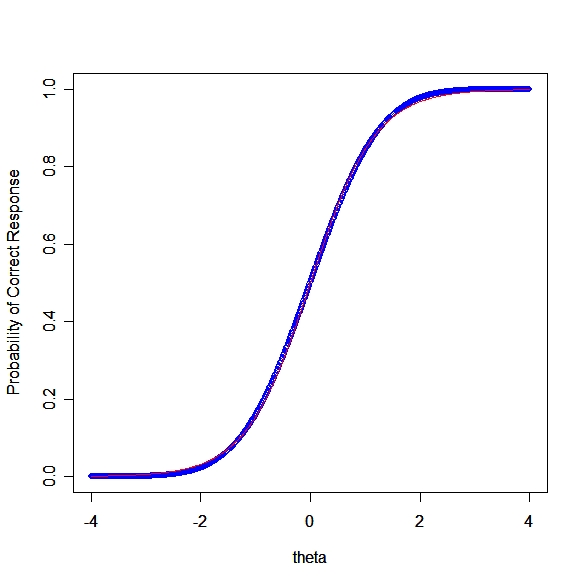
如何思考这个问题呢?我们还是用推铅球这个例子。由于某种原因,我们无法直接测量了,比如没有尺子并且是夜晚。那怎么比赛呢,于是我们选几个离河边远近不同的几个测试点,然后在每个点放一堆大小相同的铅球。虽然我们不能测量,但是我们仍然能区分铅球是否落水,听到落水声就得1分,否则0分。就好像做选择题,我们能判断是否选择了正确的选项。由于每个测试点离河边远近的距离都不同,铅球的大小也不同,而且河岸的形状也有变化,所以每个测试点的难度也不同。但是同一个选手在状态相同的情况下,测试结果理论上是相同的。我们将会根据每个测试点选手的表现来估计其能力水平。如果按照总分把所有选手分成高分组和低分组,对于同一个测试点,我们会发现高分组的通过率会高于低分组,如果从群体中随机选取一个选手的话,来自高分组的选手将会有更高的概率通过,而低分组的选手则通过率会比较低。如果我们以选手的能力为横坐标,以通过某个测试点的概率为纵轴,那么就得到下面的曲线。
IRT ICC 项目特征曲线

从这个项目特征曲线中我们可以看到,随着能力(theta)的提高,答对这个题目的概率也在提升。不同题目的曲线也不同,也许你已经想象出一道更简单题的题目的项目特征曲线将会相对这条曲线左移,而难题的曲线则右移。假如通过大量的测验知道了每个题目的项目特征曲线,那么我们就可以根据选手对一组题目的作答情况来估测其能力水平。即便是两个选手作答的两组试题并不相同,我们也能够比较两个选手的能力高低了。

当然项目特征曲线有简单的也有复杂的,简单1个参数(难度),也有2个(难度,区分度)或3个参数(难度,区分度和猜测参数)的,也就是所谓1P模型,2P,3P模型。

了解更多关于IRT的知识,请参考学习资料见:IRT learning resources - Chunlei’s Blog

为了更好解释项目反映理论,我曾经想过很多其他的例子,但是还是觉得推铅球这个例子最好,最能深入浅出,又不失去科学性。但是好的例子往往不是一下子就想到的,而且往往需要比较后才能选择出来,我以前想到的例子也列出来,读者可以自己比较比较。

A 抛硬币或者骰子
B 测量身高
C 摸高
D 跳高

比较的依据:
1 是否用来衡量某种能力
2 是否可测量,与经典测量理论相联系
3 群体的这种能力的分布是否为正态分布
4 是否能解决不同尺子测量结果比较的问题

There are a lot learing resources for IRT(Item Response Theory). But the most useful onese are those fit you well.

Here is a list which helped me a lot.
Books:
The Basics of Item Response Theory: Frank B. Baker: 9781886047037: Amazon.com: Books-link
Item Response Theory: Parameter Estimation Techniques, Second Edition (Statistics: A Series of Textbooks and Monographs): Frank B. Baker, Seock-Ho Kim: 9780824758257: Amazon.com: Books link

Vedios:
A Conceptual Introduction to Item Response - YouTube

Pdf Documents:
A visual guide to item response theory VisualIRT.pdf
IRT mini-tutorial interactive
The Basics of Item Response Theory (by Frank Baker)

Slides:
IRT - Item response Theory
基于项目反映理论_宋慧鹏

Websites:
Item Response Theory GOOD
Item Response Theory cas.usf.edu

Softwares:
SSI - Scientific Software International, Inc.
WinGen: Windows software that Generates IRT parameters and item responses

###Seven Principles for Good Practice in Undergraduate Education (Chickering & Gamson, 1987):

  1. Good practice encourages interaction between students and faculty.
  2. Good practice encourages interaction and collaboration between students.
  3. Good practice uses active learning techniques.
  4. Good practice gives prompt feedback.
  5. Good practice emphasizes time on task.
  6. Good practice communicates high expectations.
  7. Good practice respects diversity—talents, experience, and ways of learning.

###Seven Learner-Centered Principles to Improve Teaching (Ambrose et al., 2010):

  1. Students’ prior knowledge can help or hinder learning.
  2. How students organize knowledge influences how they learn and apply what they know.
  3. Students’ motivation determines, directs, and sustains what they do to learn.
  4. To develop mastery, students must acquire component skills, practice integrating them, and know when to apply what they have learned.
  5. Goal-directed practice coupled with targeted feedback enhances the quality of students’ learning.
  6. Students’ current level of development interacts with the social, emotional, and intellectual climate of the course to impact learning.
  7. To become self-directed learners, students must learn to monitor and adjust their approaches to learning.

Principles based on brain science(Zull, 2002):

  1. recognize the importance of emotion.
  2. help students feel in control of their learning.
  3. build on existing neuronal networks (prior knowledge), even if these networks are wrong.

The following was added 2015-02-28
###Glaser’s Seven Principles of Instruction
1 Structured Knowledge.
‘Instruction should foster increasingly articulated conceptual structures that enable inference and reasoning in various domains of knowledge and skill’ (17).

2 Use of Prior Knowledge and Cognitive Ability.
‘Relevant prior knowledge and intuition of the learner is … an important source of cognitive ability that can support and scaffold new learning … the assessment and use of cognitive abilities that arise from specific knowledge can facilitate new learning in a particular domain’ (18).

3 Metacognition Generative Cognitive Skill.
‘The use of generative self- regulatory cognitive strategies that enable individuals to reflect on, construct meaning from, and control their own activities … is a significant dimension of evolving cognitive skill in learning from childhood onward… These cognitive skills are critical to develop in instructional situations because they enhance the acquisition of knowledge by overseeing its use and by facilitating the transfer o

4 Active and Procedural Use of Knowledge in Meaningful Contexts.
‘Learning activities must emphasize the acquisition of knowledge, but this information must be connected with the conditions of its use and procedures for its applicability… School learning activities must be contextualized and situated so that the goals of the enterprise are apparent to the participants’ (19, emphasis in original).

5 Social Participation and Social Cognition.
‘The social display and social modelling of cognitive competence through group participation is a pervasive mechanism for the internalization and acquisition of knowledge and skill in individuals. Learning environments that involve dialogue with teachers and between peers provide opportunities for learners to share, critique, think with, and add to a common knowledge base’ (19)

6 Holistic Situations for Learning.
‘Learners understand the goals and meanings of an activity as they attain specific competencies… Competence is best developed through learning that takes place in the course of supported cognitive apprenticeship abilities within larger task contexts’ (19-20).

7 Making Thinking Overt.
‘Design situations in which the thinking of the learner is made apparent and overt to the teacher and to students. In this way, student thinking can be examined, questioned, and shaped as an active object of constructive learning’ (20).

###Psychologists Identify the Best Ways to Study
click here for more details

  1. Self-Testing: Quizzing Yourself Gets High Marks
  2. Distributed Practice: For Best Results, Spread Your Study over Time
  3. Elaborative Interrogation: Channel Your Inner Four-Year-Old
  4. Self-Explanation: How Do I Know?
  5. Interleaved Practice: Mixing Apples and Oranges
    自测,分散复习,自我审问和解释,混合练习。

High Leverage Practices
read more

  1. Making content explicit through explanation, modeling, representations, and examples
  2. Leading a whole-class discussion
  3. Eliciting and interpreting individual students’ thinking
  4. Establishing norms and routines for classroom discourse central to the subject-matter domain
  5. Recognizing particular common patterns of student thinking in a subject-matter domain
  6. Identifying and implementing an instructional response to common patterns of student thinking
  7. Teaching a lesson or segment of instruction
  8. Implementing organizational routines, procedures, and strategies to support a learning environment
  9. Setting up and managing small group work
  10. Engaging in strategic relationship-building conversations with students
  11. Setting long- and short-term learning goals for students referenced to external benchmarks
  12. Appraising, choosing, and modifying tasks and texts for a specific learning goal
  13. Designing a sequence of lessons toward a specific learning goal
  14. Selecting and using particular methods to check understanding and monitor student learning
  15. Composing, selecting, interpreting, and using information from methods of summative assessment
  16. Providing oral and written feedback to students on their work
  17. Communicating about a student with a parent or guardian
  18. Analyzing instruction for the purpose of improving
  19. Communicating with other professionals

References:
Ambrose, S. A., Bridges, M. W., DiPietro, M. Lovett, M. C., & Norman, M. K. (2010). How learning works: Seven research-based principles for smart teaching. San Francisco, CA: Jossey-Bass.
Chickering, A. W., & Gamson, Z. F. (1987, March). Seven principles for good practice in undergraduate education. American Association for Higher Education Bulletin, 39(7), 3-7.
Zull, J. E. (2002). The art of changing the brain: Enriching the practice of teaching by exploring the biology of learning. Sterling, VA: Stylus.
GLASER, R. (1995). Application and theory: Learning theory and the design of learning environments. Paper presented at the 23rd International Congress of Applied Psychology, July 17-22,1994, Madrid,Spain.
Duschl, R. A., & Osborne, J. (2002). Supporting and Promoting Argumentation Discourse in Science Education. Studies in Science Education. doi:10.1080/03057260208560187
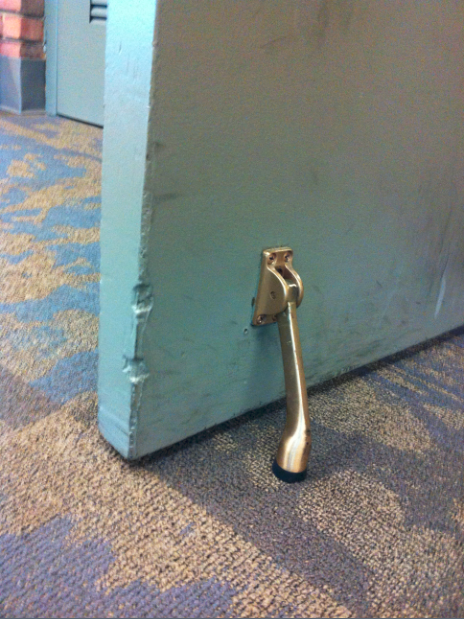
Today I saw this in our main library when the staff cleanup the restroom.
Door with leg
What a cool leg the door has! The idea is simple, but the result is so good. Sometimes simple change can make a big difference.

There also some design confuses me. Here is a table with sharp edge on the top surface. I really cannot understand what this edge serves for beyound hurting my arms when typing on my laptop.
Sharp edge table

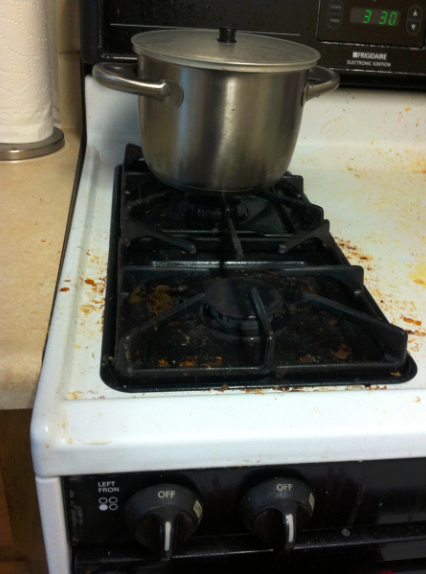
Another example of confusing design. I really don’t know witch controler can light a fire to the stove under my pot.
gas stove

Nowadays, the environment is becoming worse and worse. One basic reason is bad design. Our company design good batteries with low-cost but ignored how to recycle and reuse the waste batteries. Similarly, the white pollution, air and water pollution all failded to take environment pollution cost into concern. These industries are all good examples of bad design and are badly need to change.

Well, how to solve these problems and create better future? The answer is design zero pollution industry pipeline. Just like the nature design all kinds of lives, no waste at all. For example, how to make use of clean energy as power for travelling. When you taking whole process into concern, you will find the horse and cart is one example of good designs. Of course, we will not return to this old method of travelling, but we really should rethink this design.

It is not just product design or pipeline design. It is also a life design. On behavior researcher found a very simple and effective way to save energy– sending a letter of electric usage report comparing with neighborhood. After being told use more than twice electric than neighborhood, people tend to pay much attention to save energy. This is just how behavior science used to affect personal life styles.

Nowadays, people have learnt to make use clean energy such as wind, water,sun. Researchers are also trying to invent new technologies of producing and storing and converting these energy. We are going to and have to achieve no waste design in order to live a better life for long run on earth.

亲爱的老婆圣诞节快乐!

今天是12月25号,我离开家到美国访学刚好5个月整。这五个月我知道老婆特别辛苦,也受了不少委屈,不仅仅是因为我在地球的另一端,你没了往日的依靠,而是你还要担负着做不满周岁的宝宝的母亲的责任,以及家庭和工作的双重重担。

2013年2月12号,我们的宝宝然然出生了:)。由于长时间坐着哺乳,大腿血液流通不畅造成了局部组织坏死,你的大腿上留下了两块死斑。你修完产假已经快要放暑假了,我就劝你别去上班了,你说不能耽误工作,结果还是上班了。我知道你很有责任心,也不娇气,但是我还是心疼。

7月25号我出国访学,你送我到机场,当飞机起飞的那一刹那,我的心情很沉重,我知道你将担负起整个家庭的责任。婆媳关系本来就难处,但你却处理的很好,从没有跟妈拌过嘴。

QQ聊天时你经常跟我说头晕,我知道你睡眠不足。你经常要熬夜赶稿子,我嘴上说“不要把工作带到家里”,实际上是不想你熬夜,因为我知道你第二天还要早起,要坐两个小时的公交车才能到学校。以前在家里,一般都是我送你出门,你经常来不及在家吃早饭,到了包子铺,你拿了包子就走,我来结账,就是为了赶时间,不迟到。

11月4号下午爸突发脑出血,是你带爸及时去了医院救治,幸亏救治及时咱爸才保平安。当天晚上你守了爸一夜,端屎端尿,这些本来应该是我来做的。我跟妈说,桃子不仅是我的老婆,还是宝宝的妈妈,你们的儿媳,而且还做了本应该由我这个儿子做的事情,你就像对我这个儿子一样对待这个儿媳吧。我也因为你只顾忙着工作,忽略了家里,生过你的气,但是有什么办法呢,该做的总是要做的。但是我还是要说你,健康是第一重要的,下次体检一定要去,要抽出些时间锻炼身体。

祝老婆永远年轻、健康、漂亮!

爱你的老公
12月24日 圣诞夜
于佐治亚

##中文
###已读
小说类
红楼梦
天眼
一花一世界
佛本是道
神游
生命是什么

###在读
史记
老子
庄子

###未读
论语
孟子
易经
大学
孟子
冰鉴

佐治亚神游而作

雾云山
(起笔)
仙踪浩渺远云山
雾雨清濛锁玉颜
敢问天人何处去
携天月下了人间


雾云山
(收笔)
仙踪浩渺远人烟
雾雨清濛锁玉颜
挂月楼台空伫立
神游欲海了无边


雾云山
(有意无律)
仙踪飘渺雾云山
悟心空待百花岩
天月不知何处去
身化万千在人间


雾云山
(破笔)
敢问天师何所在
天宫莫去去人间

欲问天人何处在
天宫莫去去人间

欲问云梯何处在
天宫莫去在人间

挂月楼台空伫立
遥盼玉颜下凡间

拜问天人何处去
不在远山在人间

0%